Aims and Scope
The Brazilian Journal of Health Aromatherapy and Essential Oil (BJHAE) (ISSN 2965-7253), presented under the editorial identity Brazilian Journal of Health, is an international, open-access, peer-reviewed scientific journal published in continuous flow. The journal is dedicated to the dissemination of high-quality research in the field of health sciences, encompassing basic, clinical, translational, experimental, and applied investigations related to human health, disease processes, prevention, care, and health promotion.
BJHAE positions itself as a multidisciplinary and integrative scientific journal in health, welcoming contributions from all areas of health and biomedical sciences, including, but not limited to, medicine, nursing, pharmacy, physiotherapy, nutrition, psychology, dentistry, biomedicine, public health, basic and translational sciences, health technologies, health education, and evidence-based integrative practices.
The journal values scientific approaches that connect different levels of investigation, from molecular and cellular mechanisms to clinical practice, population health, technological innovation, and contemporary models of health care. In this context, studies involving natural products, bioactive compounds, essential oils, aromatherapy, phytotherapy, integrative interventions, and their impacts on health may be considered, provided that they are grounded in rigorous scientific methodology, ethical standards, and appropriate academic framing.
Scope of the Journal
The scope of the journal includes, but is not limited to:
Basic, Biomolecular, and Physiological Sciences
Experimental and theoretical studies involving cellular, molecular, biochemical, anatomical, physiological, and pathophysiological mechanisms related to health, disease, and biological responses to different therapeutic interventions.
Clinical and Translational Research
Clinical trials, observational studies, translational research, case reports, clinical protocols, and evidence-based clinical investigations across different health specialties, including the evaluation of therapeutic interventions, care strategies, prevention, rehabilitation, and patient-centered outcomes.
Public Health, Epidemiology, and Health Systems
Research focused on population health, health promotion, disease prevention, epidemiology, public policies, health system organization, implementation science, and strategies aimed at improving health outcomes at individual and population levels.
Pharmacology, Toxicology, and Safety Assessment
Studies related to pharmacological mechanisms, toxicology, safety assessment, interactions, risk analysis, dosage considerations, and the rational use of substances, compounds, products, and therapeutic interventions.
Natural Products and Bioactive Compounds
Research involving natural products, plant-derived compounds, essential oils, phytochemicals, bioactive molecules, pharmacological properties, therapeutic potential, mechanisms of action, safety, and clinical or experimental applications in health.
Innovation, Technology, and Emerging Methods in Health
Research integrating health with technology, data science, artificial intelligence, digital health, diagnostic and therapeutic methods, health innovation, and emerging models of health care delivery.
Education, Professional Training, and Knowledge Translation in Health
Studies addressing health education, professional training, curriculum development, pedagogical practices, scientific communication, continuing education, and knowledge dissemination strategies in health-related fields.
Integrative Practices and Evidence-Based Complementary Approaches
Scientific investigations of integrative and complementary practices, including aromatherapy, phytotherapy, lifestyle interventions, and the use of essential oils, when analyzed through critical, methodological, and evidence-based perspectives.
Traditional and Intercultural Knowledge in Health
Analyses of traditional knowledge, cultural practices, and intercultural perspectives related to health, provided that they are scientifically, historically, ethically, or critically contextualized, avoiding unsupported empirical claims or non-scientific interpretations.
Editorial Standards and Scientific Rigor
BJHAE strictly adopts international standards of scientific publishing and research ethics. All manuscripts undergo a double-blind peer-review process, ensuring impartiality, methodological quality, and scientific integrity. The journal follows ethical principles related to responsible authorship, conflict of interest disclosure, research integrity, data transparency, and the protection of human and animal research subjects when applicable.
The journal prioritizes original, methodologically sound, ethically conducted, and scientifically relevant contributions to the advancement of health sciences. BJHAE does not accept promotional language, commercial bias, unsupported therapeutic claims, or approaches lacking scientific foundation.
Types of Articles Accepted
BJHAE accepts the following types of manuscripts:
- Original Articles
- Review Articles
- Mini-Reviews
- Scoping Reviews
- Systematic Reviews
- Case Reports
- Clinical Images
- Experience Reports with scientific framing
- Medical Hypotheses
- Letters to the Editor
- Correspondence and Comments
- Editorials, when invited or approved by the editorial board
International Reach and Inclusivity
BJHAE encourages submissions from researchers, health professionals, educators, and institutions from all regions of the world. The journal values academic diversity, international collaboration, interdisciplinary dialogue, and the exchange of scientific knowledge across different health systems, cultural contexts, and scientific traditions.
Scientific Mission
The mission of BJHAE is to contribute to the advancement of health sciences through the dissemination of rigorous, interdisciplinary, and ethically grounded scientific knowledge, promoting integration among research, clinical practice, education, innovation, natural products, integrative health, and public health at a global level.
For further information, please contact the editorial office at:
bjharomatherapyessentialoil@gmail.com
Current Issue
Vol. 3 No. 1 (2026): January to December - 2026
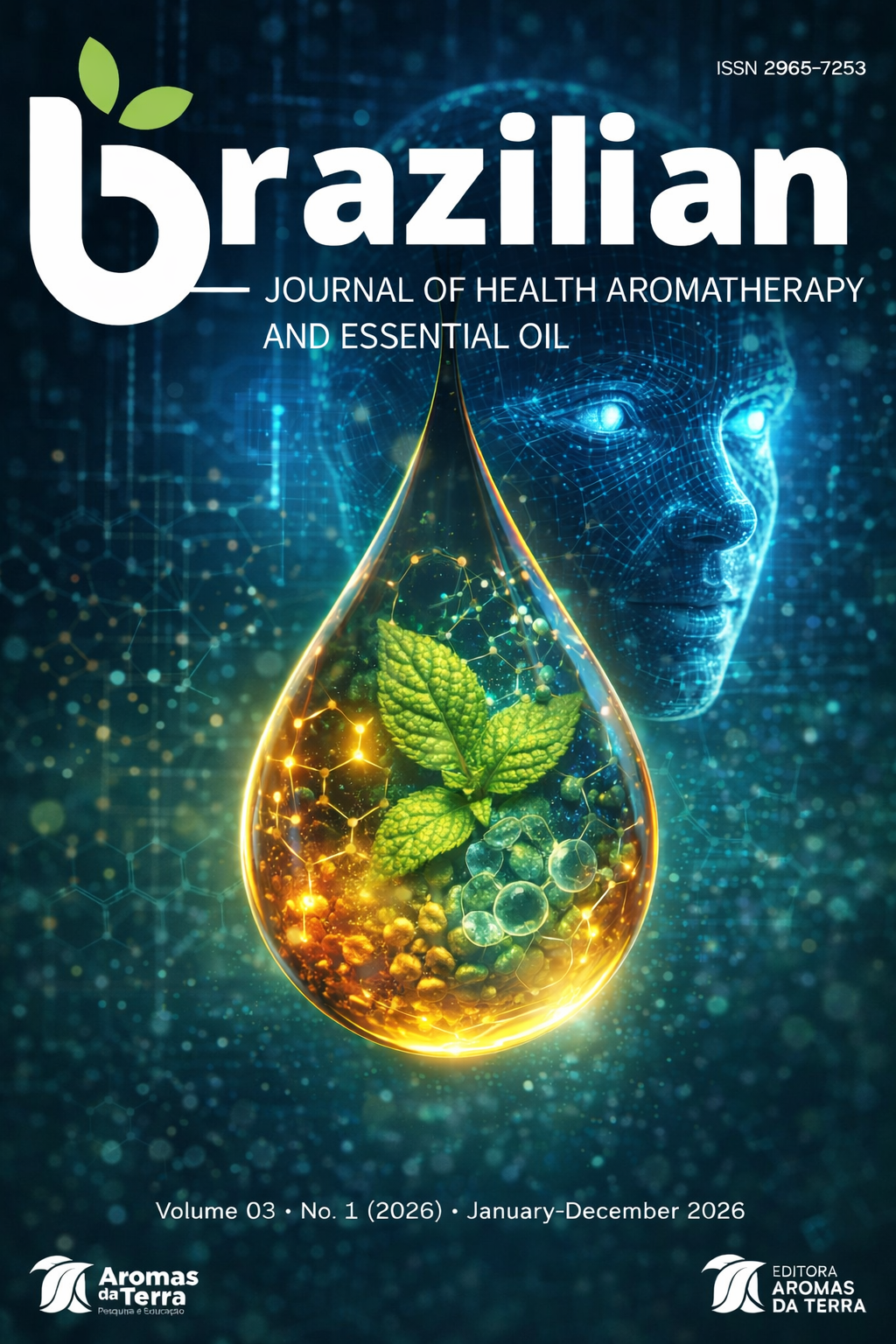
In the 2026 edition, we open with the Editorial entitled “Essential Oils at the Interface of Nature, Technology, and Human Health”, a reflection that mirrors both the scientific direction of this issue and the symbolic depth expressed on our cover. The image of a human face interwoven with digital networks and a luminous drop containing botanical elements represents the core mission of this journal, which is to bridge traditional natural knowledge with modern scientific and technological advances.
This editorial explores how aromatherapy and essential oil research have evolved into a truly integrative science that connects molecular biology, neuroscience, inflammation, metabolism, and clinical practice. It highlights the growing body of evidence demonstrating that essential oils are not merely complementary tools, but biologically active agents capable of interacting with complex physiological systems through well-defined mechanisms.
Special emphasis is placed on the convergence between innovation and scientific rigor. Advances in analytical chemistry, omics technologies, digital health tools, and translational research models are reshaping how essential oils are studied, validated, and applied. The editorial reinforces the need for methodological robustness, reproducibility, and ethical standards, ensuring that scientific progress remains aligned with safety, efficacy, and professional responsibility.
Finally, this edition underscores the importance of interdisciplinary collaboration by bringing together researchers, clinicians, pharmacists, and health professionals with the goal of transforming essential oil science into meaningful health solutions. By integrating nature-derived compounds with cutting-edge science, this journal continues to support the maturation of aromatherapy as a field that is both scientifically grounded and clinically relevant in contemporary global healthcare.
Published: 2026-01-15
Original Research
Health Review and Mini-Review
Abstract
Edited by: 
Registered in: 